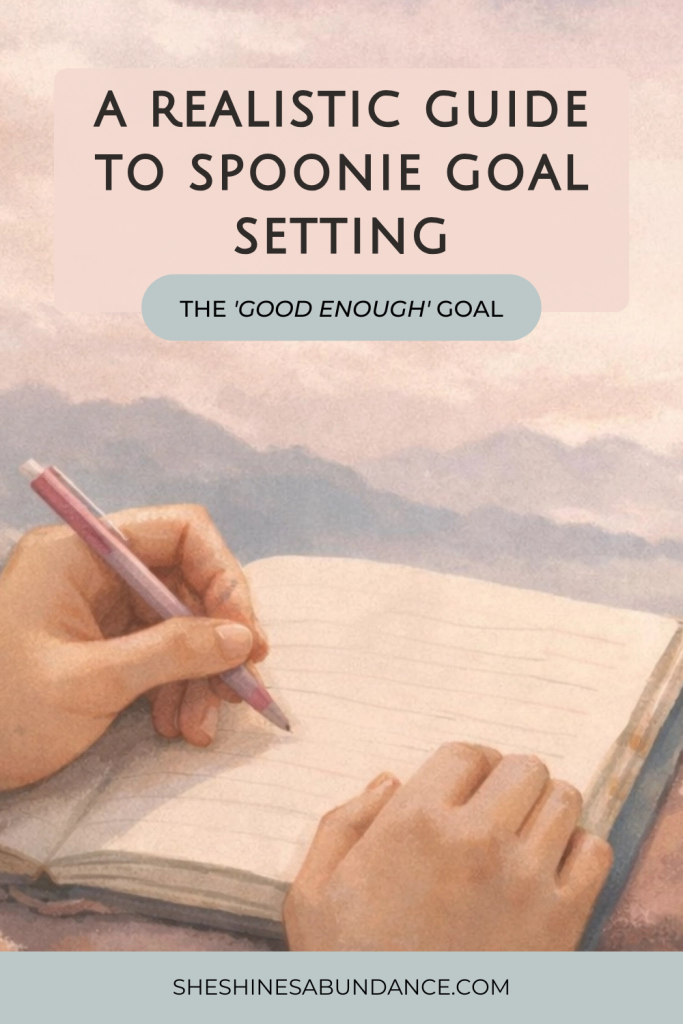
Spoonie goal setting can feel damn near impossible when you’re three days into a flare and can barely manage a shower.
January arrives every year with the same bloody energy, New Year, New Me, and if you’re chronically ill, neurodivergent, or just burnt out from surviving, it feels like the world is screaming at you to be better, faster, stronger. Meanwhile, you’re just trying to remember if you took your meds this morning.
I’ve been there. I’ve set those big, shiny goals. I’ve written them in fancy journals, colour-coded them, made vision boards. And then I’ve watched myself fail spectacularly because my body had other plans. The guilt that follows? It’s heavy. You start to wonder if you’re just not trying hard enough, if everyone else can do it, why can’t you?
Here’s the truth most people won’t tell you: traditional goal-setting wasn’t designed for bodies like ours. It was built for people with predictable energy, stable health, and nervous systems that aren’t constantly scanning for danger. So let’s talk about something different, something that actually works when you’re living with chronic illness. Let’s talk about spoonie goal setting and the power of the “good enough” goal.
Why Your Brain Hates Big Goals When You’re in Survival Mode
If you’ve ever set a goal and then felt paralysed by the thought of actually doing it, you’re not broken. You’re just operating from a nervous system that’s stuck in survival mode.
When you’re chronically ill or dealing with trauma, your brain is already working overtime. It’s managing pain signals, processing symptoms, trying to predict the next flare, and keeping you safe from perceived threats (even when the “threat” is just your own body betraying you). This is what I call survival mode productivity, you’re using every ounce of energy just to exist, let alone thrive.

Big goals require planning, future-thinking, and sustained energy. But when your nervous system is in fight-or-flight mode, your brain literally can’t access those higher-level thinking skills. It’s too busy keeping you alive.
So when you set a goal like “exercise five times a week” or “start a side business” and then can’t follow through, it’s not a character flaw. Your brain is doing exactly what it’s supposed to do, prioritising survival over achievement.
This is where realistic goals for chronic illness come in. We’re not lowering the bar because we’re lazy or unmotivated. We’re adjusting the bar to match the reality of our bodies and our energy levels.
Intentions vs. Goals: Why the Shift Matters for Your Mental Health
Here’s something I wish someone had told me years ago: there’s a massive difference between goals and intentions.
Goals are outcome-focused. They’re about ticking boxes, hitting targets, and measuring success. Goals ask: Did I do it? And when you’re chronically ill, the answer is often “no,” which leads to a shame spiral that does absolutely nothing for your healing.
Intentions, on the other hand, are about direction. They’re about how you want to feel or be, not what you want to achieve. Intentions ask: Am I moving towards what matters to me, even in tiny ways?
Setting intentions with chronic illness gives you permission to be flexible. It allows for flare days, bad mental health days, and the reality that some weeks you’ll have three spoons and other weeks you might have ten.
Here’s what this looks like in practice:
- Goal: “I will meditate for 20 minutes every morning.”
- Intention: “I want to start my day with more calm and presence.”
The goal has one outcome. The intention has infinite pathways. Maybe today, calm looks like three deep breaths before you get out of bed. Maybe next week, it looks like sitting outside with your coffee. Both are valid. Both count.
This is the foundation of spoonie goal setting, we’re not abandoning our dreams or settling for less. We’re just removing the rigid structures that make us feel like failures when our bodies don’t cooperate.
The Spoonie Goal Setting Framework: How to Actually Do This Without Burning Out
Alright, let’s get practical. If traditional goal-setting doesn’t work for us, what does? Here’s the step-by-step framework I use, and it’s built entirely around the concept of “good enough.”
Step 1: Calculate Your Energy Budget
Before you set any goal, you need to know how many spoons you’re working with. According to spoon theory, different tasks cost different amounts of energy. Getting out of bed might cost one spoon. Showering costs two. Cooking a meal costs three. Working or socialising might cost four or more.
Your energy budget fluctuates daily (sometimes hourly), so this isn’t about perfection. It’s about awareness. On a good day, you might have 12 spoons. On a flare day, you might have 3.
Start here: For one week, track how many spoons different tasks cost you. Notice patterns. Notice what drains you and what (surprisingly) energises you.
This is pacing for chronic illness in action. You can’t pace yourself if you don’t know your baseline.
Step 2: Identify What Actually Matters to You
This is where things get real. Strip away the “shoulds” and the expectations from well-meaning family members or Instagram influencers. What do you actually want?
Ask yourself:
- What would make my life feel a little softer?
- What would bring me a sense of peace or purpose?
- What do I keep saying I want to do but never get around to?
Write these down. Don’t filter them. Don’t judge them. Just get them out of your head.
Step 3: Shrink It Down to “Good Enough”
Here’s where the magic happens. Take whatever you wrote down and make it smaller. Then make it smaller again. Then shrink it one more time until it feels almost laughably easy.
Let’s say you wrote “I want to be healthier.” That’s vague and overwhelming. Let’s break it down:
- Big Goal: Exercise 5 times a week for 30 minutes.
- Smaller Goal: Move my body 3 times a week for 15 minutes.
- Good Enough Goal: Do gentle stretches in bed for 5 minutes, 2 times this week.
The “good enough” goal is achievable even on a medium-energy day. And here’s the beautiful part: if you exceed it, that’s a bonus. But if you only hit the “good enough” version, you still succeeded.

Step 4: Build in Flexibility and Rest
This is non-negotiable. Your spoonie goal setting plan must include built-in rest and the option to pivot.
I use what I call the “Rule of Two”: I only plan for two productive tasks per day. Everything else is a bonus. If I wake up in a flare, I can drop one (or both) without guilt because I’ve already given myself permission.
Also, schedule rest days. Literally put them in your calendar. Rest is not something you “earn” after being productive. Rest is part of the productivity cycle, especially for bodies like ours.
Step 5: Redefine Success
Success is not “I did everything perfectly.” Success is:
- I showed up, even when it was hard.
- I adjusted my expectations when my body needed me to.
- I didn’t abandon myself when things didn’t go to plan.
Chronic illness mindset shifts are about unlearning the toxic productivity culture we’ve been drowning in. You don’t have to earn your worth through achievement. You are inherently valuable, even on the days you do absolutely nothing.
The “Done is Better Than Perfect” Mindset for Spoonies
Let’s talk about the PRECISE Spoonies for a second: those of us who are organised, methodical, and perfectionistic to a fault. If this is you, learning to stop at “good enough” might be the hardest (and most important) lesson of your life.
I used to be the person who couldn’t leave a task half-finished. If I started cleaning the kitchen, I had to clean the entire kitchen, even if it meant I’d be bedbound the next day. The concept of “good enough” felt like failure.
But here’s what I’ve learned: done is better than perfect, and “good enough” is better than burnt out.
Perfectionism isn’t about high standards. It’s a trauma response. It’s the belief that if we just do things right, we’ll finally be safe, loved, accepted. But perfectionism for spoonies is a one-way ticket to exhaustion and self-hatred.
So what does “good enough” actually look like?
- The kitchen is good enough when the dishes are in the sink (not washed, just in the sink).
- The blog post is good enough when it’s published, even if it’s not flawless.
- The workout is good enough when you did 5 minutes instead of 30.
Good enough means you let go before you’re completely drained. It means you stop when you’ve done what you can with the spoons you have, not when the task is objectively complete.

If this makes you uncomfortable, good. That discomfort is your nervous system trying to protect you from the imagined consequences of imperfection. But I promise you: nothing terrible happens when you stop at good enough. In fact, something beautiful happens: you have energy left over for the things (and people) that actually matter.
Practical Examples of “Good Enough” Goals for Chronic Illness
Still not sure how to apply this to your own life? Here are some real-world examples of spoonie goal setting in action:
Instead of: “I’m going to meal prep every Sunday for the entire week.”
Try: “I’ll prepare one easy meal or snack on a day when I have the energy.”
Instead of: “I’m going to start a daily journaling habit.”
Try: “I’ll write one sentence about how I’m feeling when I think of it.”
Instead of: “I’m going to reconnect with all my friends this month.”
Try: “I’ll send one low-effort text to one person I miss.”
Instead of: “I’m going to read 50 books this year.”
Try: “I’ll read a few pages before bed when I feel like it.”
Notice the pattern? We’re removing timelines, rigid structures, and all-or-nothing thinking. We’re making space for your body to have a say in what’s achievable.
And if you’re someone who thrives on structure (like me), you can still have it: just make it flexible structure. Use tools like spoon theory to prioritise your tasks, and give yourself permission to adjust daily based on your energy levels.
Why This Actually Works: The Science Behind Tiny Wins
You might be thinking, “But if I only do tiny things, how will I ever achieve anything meaningful?”
Fair question. Here’s the answer: tiny, consistent actions compound over time. But more importantly, they keep your nervous system regulated, which is the actual foundation for any kind of sustainable change.
When you set a massive goal and fail, your brain registers that as a threat. It releases stress hormones. It reinforces the belief that you’re not capable. And next time you try to set a goal, your nervous system is already primed to protect you from that perceived failure by not letting you start at all.
But when you set a tiny goal and achieve it? Your brain gets a hit of dopamine. It registers success. It starts to believe that change is possible. And slowly, over time, your nervous system begins to feel safe enough to try bigger things.
This is why the free Nervous System Reset Cards I created are so effective. They’re 60-second micro-practices that help you regulate your nervous system in the moment, without requiring a massive time or energy commitment. Because sometimes, the most powerful goal you can set is simply: “I’m going to help my body feel a little safer today.”
How to Handle the Guilt When “Good Enough” Feels Like Giving Up
Let me guess: part of you is reading this and thinking, “But what if I’m just making excuses? What if I’m being lazy?”
I get it. That voice is loud, especially if you’ve spent years being told (or telling yourself) that you’re not doing enough.
So let’s address it head-on: choosing “good enough” is not the same as giving up. It’s choosing sustainability over burnout. It’s choosing self-compassion over self-destruction. It’s choosing to honour the reality of your body instead of punishing it for not being “normal.”
You wouldn’t tell someone with a broken leg to run a marathon. So why are you expecting your chronically ill, traumatised, or neurodivergent body to function like it’s fully resourced?
The guilt you feel isn’t proof that you’re doing something wrong. It’s proof that you’ve been conditioned to believe your worth is tied to your productivity. And unlearning that? That’s the real work.
You’re allowed to do less. You’re allowed to rest. You’re allowed to adjust your goals when your body asks you to. And you’re still worthy, even when you’re doing none of it.
Your Next Step: Start Small, Start Now
Here’s what I want you to do after you finish reading this:
- Pick one area of your life where you’ve been beating yourself up for not doing enough.
- Write down the “ideal” goal you’ve been holding onto (the one that makes you feel guilty when you don’t achieve it).
- Shrink it down to the smallest, most achievable version: your “good enough” goal.
- Try it for one week. Just one. See how it feels. Notice if the guilt lessens. Notice if you actually follow through.
And if you need support regulating your nervous system while you do this (because let’s be honest, changing your relationship with goals brings up a lot of emotional stuff), grab the free Nervous System Reset Cards. They’re designed specifically for moments when your body is overwhelmed and you need to come back to calm: fast.
Spoonie goal setting isn’t about lowering your standards. It’s about raising your self-compassion. It’s about recognising that your body is doing the best it can with the resources it has. And sometimes, the most radical thing you can do is let “good enough” be enough.
You’re not failing. You’re adapting. And that, my friend, is a form of strength most people will never understand.

Related reading: If you’re also navigating the emotional weight of chronic illness, you might find comfort in Grief: Losing the Life You Thought You’d Have or How to Find Hope When You Feel Hopeless.
If this hits you hard….
You’re exactly who I write for. You don’t have to grieve this alone.
- Download my FREE 60 Second Nervous System Reset Cards
- Join our newsletter – fill out the form below
- Save this post on Pinterest so you can return to it on tough days 👉