
Content note: this post talks about medical dismissal, medical trauma and chronic illness. Please look after yourself while you read, and come back later if you need to.
I knew before I sat down in that cardiologist’s office that I wasn’t going to be believed.
Nobody had said anything yet. Nobody had even looked at me. But my heart was already going, my shoulders were up around my ears, and I was running through what I’d say and how I’d say it so I didn’t sound “anxious”.
My body had decided how that appointment would go before the doctor had a chance to.
And it was right.
For a long time I thought that feeling was just me being dramatic. Now, after years of my own medical history and what I’m learning in my trauma healing training, I understand it differently. It wasn’t drama. It was my nervous system doing exactly what it had been taught to do.
That’s what this post is about. Not the stories (I’ve told a few of those, and I’ve just written about FND and being told it’s all in your head), but what actually happens inside you when the people who are supposed to help keep telling you nothing’s wrong.
First, what is medical gaslighting?
“Medical gaslighting” isn’t a clinical term. It’s a phrase people use when a health professional dismisses or downplays your symptoms, or puts them down to stress, anxiety or “your weight” or “your age” without properly looking into them. The message underneath is: you’re wrong about your own body.
To be fair, not every rushed or frustrating appointment is gaslighting. Doctors are stretched, and medicine genuinely doesn’t have all the answers. But when it happens over and over, especially for years, especially when you turn out to have been right the whole time, it leaves a mark. And that mark doesn’t just sit in your memory. It sits in your body.
In the rest of this post I’m going through:
- why being dismissed by a doctor hits harder than being dismissed by anyone else
- six ways it can show up in your body (going blank in appointments is one of them)
- the loop that keeps a lot of us stuck, and why being anxious doesn’t mean your symptoms are anxiety
- what’s actually helping me, and what my training says about repair
Quick note: I’m sharing my lived experience and what I’m learning as a Level 2 Trauma Healing Practitioner working towards Level 3. I’m not a doctor or a psychologist, and this isn’t medical or psychological advice.
Your nervous system is always asking one question
Underneath everything, your nervous system is constantly asking: am I safe right now?
In my training, this gets called neuroception, a term from Stephen Porges’ polyvagal theory. It’s the idea that your body is scanning for safety and danger all the time, below conscious thought. You don’t decide to feel unsafe. Your body decides first and tells you after.
And it learns from experience. If something hurt you before, your system remembers the setting, the smells, the tone of voice, the feeling in your stomach. Next time it sees those cues, it gets ready before you’ve worked out why.
So when you’re dismissed in a doctor’s office once, it’s a bad day. When it happens again and again, your body starts filing that whole environment under danger. The waiting room. The paper on the bed. The doctor glancing at the clock. That’s not you being irrational. That’s learning.
Why it hits harder from a doctor
Being brushed off by a stranger stings. Being brushed off by a doctor does something different, and there’s research that helps explain why.
Psychologists Jennifer Freyd and Carly Smith call it institutional betrayal: harm done by the very system you depend on for safety. Their research has found that when an institution meant to protect you lets you down, it’s linked with more trauma symptoms, not less. Because you can’t just walk away from it. You still need it. You have to go back.
There’s also a long line of research showing women’s pain is more likely to be underestimated or put down to emotional causes than men’s. If you’ve got a history of anxiety or depression on your file, that can make it worse. Once that label is there, everything new tends to get read through it.
For a lot of us, it also lands on top of something older. For me, the rules growing up were “I won’t be believed” and “stop talking about it”. The doctors didn’t teach me that. They just confirmed it.
Six ways it can show up in your body
Everyone’s different, and you might recognise all of these or none. But these are the patterns I see most, in myself and in the women I talk to.
1. Bracing before you even get there. Racing heart in the car park. Bad sleep the night before. Rehearsing exactly how to describe a symptom so you sound “credible”. Your body is preparing for a threat it’s learned to expect.
2. Going blank in the room. You walk in with five things to say and walk out having said one. That’s not you being disorganised. When your system senses threat, the thinking, planning, words part of your brain tends to go quieter so your body can focus on getting through. Great for running from danger. Terrible for explaining six months of symptoms in eight minutes.
3. Playing it down. “It’s probably nothing.” “Sorry to waste your time.” Smiling, agreeing, saying it’s “not that bad” when it absolutely is. This is often a fawn response: keeping the person with power over you happy so you stay safe. If you grew up having to keep the peace, this one can be automatic.
4. Or coming in swinging. The opposite also happens. You walk in armoured, over-prepared, ready for a fight. Which makes total sense after years of not being heard. The cruel bit is that it can get you labelled “difficult” or “anxious”, which feeds straight back into being dismissed.
5. Losing trust in your own body’s signals. When you’re told for years that what you feel isn’t real, you start to doubt it yourself. I walked on a crushed foot for two days. I went two weeks without getting a broken arm checked. I’ve got a high pain threshold, and I can’t say for sure that’s all from being dismissed, but I know part of me had stopped believing my pain was worth taking seriously. I still second guess my FND diagnosis some days, even though it makes complete sense.
6. Avoiding care altogether. These days I put off going to the doctor unless I absolutely have to. That’s not stubbornness. That’s a nervous system protecting me from something that hurt. The risk is that real things get missed, which is exactly why this matters.

The loop that keeps you stuck
Here’s the part that made me so angry when I first understood it.
You’ve been dismissed, so you walk in already dysregulated. Heart racing, shaking, words tangled. The doctor sees someone who looks anxious. They decide it’s anxiety. You get dismissed again. Next time you’re even more braced. And round it goes.
That’s basically what happened at my tilt table test. I walked in already knowing I wouldn’t be heard. The room was so cold I was shaking, and they couldn’t even get a proper blood pressure reading. My body was doing everything a body does when it’s cold, scared and unwell. And the conclusion was: woman with a history of anxiety, so it’s anxiety.
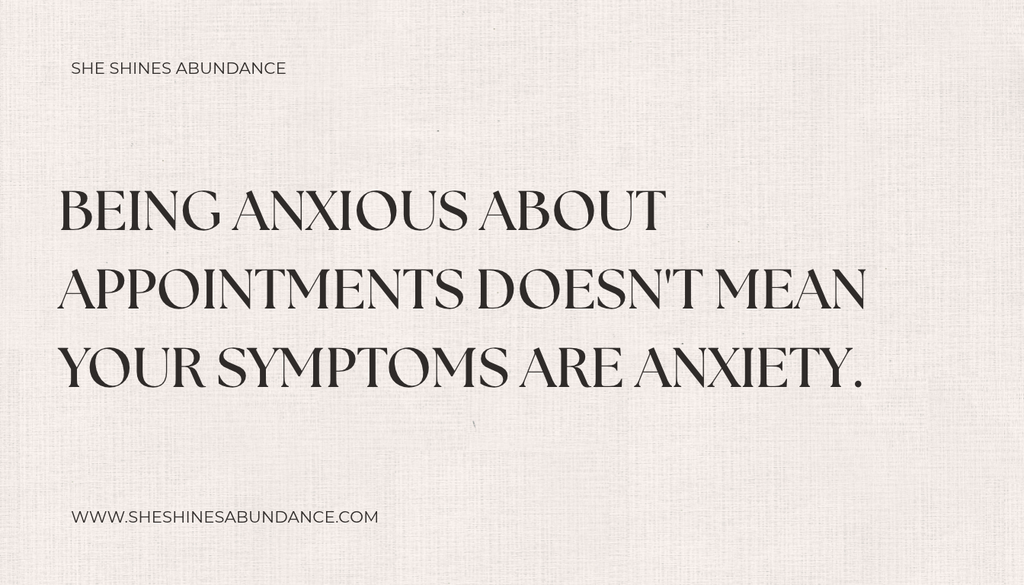
So I want to say this as clearly as I can: being anxious about appointments doesn’t mean your symptoms are anxiety. Both can be true at once. Your nervous system reacting to a place that’s hurt you before is a completely separate thing from whatever brought you there.
The other part of the loop is the body itself. Living braced for years is a lot of extra load. For many people with chronic illness, ongoing stress can make symptoms flare. That’s a big part of my FND story, which I’ve written about here. It doesn’t mean stress caused your illness. It means the dismissal can make it harder to live with.
Your body learned this. It can learn something else.
This is the hopeful bit, and I don’t mean it in a fluffy way.
One thing I keep coming back to in my training is that the nervous system learns from new experiences too, not just old ones. It’s slow, and one good appointment won’t undo fifteen bad ones. But it adds up.
For me, the biggest shift was finding a GP who knows that I know my body. When I ask her to look at something, she doesn’t hesitate. I still get nervous before I see her. But it’s less than it used to be, and after an appointment I don’t need a whole day to come down anymore. My body is slowly updating the file.
What can help
None of these are rules, and they won’t fix a broken system. They’re things that are helping me, and that might help you take a bit of your power back.
Name it to yourself. In the car park, say it: “This is my body remembering. It’s not proof I’m wrong.” Naming what’s happening can take a bit of the edge off.
Regulate before and after. Feet flat on the floor. A longer breath out than in. Cold water on your wrists. Something to hold in your hand or your pocket. Whatever brings you down a notch, do it before you walk in and again when you walk out.
Get it on paper. If the talking part of your brain is likely to go offline, don’t make it hold everything. Write your symptoms, history and questions down and hand it over, or read from it. I’m writing a whole post on why this works so well, because it’s one of the most useful things I’ve ever done.
Bring backup. A partner, a friend, or someone on speakerphone. Someone who can say “she’s not exaggerating” or just remember what was said when you can’t.
Ask for it to be noted. If a doctor won’t order a test or a referral you’ve asked for, a lot of patient advocates suggest calmly asking, “Can you please note in my file that I asked for this and you’ve decided not to?” It isn’t a magic phrase and it can feel confronting. But it often changes the conversation.
You’re allowed to leave. You can get a second opinion. You can change doctors. You don’t owe anyone your loyalty if they won’t listen to you.
Debrief afterwards. Write down what happened and how you felt, or tell someone safe. Don’t let the appointment be the last word on what’s real.
Get support if it’s become more than nerves. If you’re having flashbacks, panic, or avoiding care you know you need, that’s worth taking to a trauma-informed therapist. In Australia, your GP can do a Mental Health Treatment Plan so you can see a psychologist with a Medicare rebate.
You’re not too sensitive
If you dread appointments, go blank in them, apologise your way through them or put them off for months, there’s nothing wrong with you. Your body learned that a place meant to help you wasn’t safe. That’s a reasonable thing for a body to learn.
It can learn something new. Slowly, and with the right people around you.
I made my Doctor Appointment Prep Kit for exactly this. It helps you get your symptoms, history and questions on paper before you walk in, so your nervous system doesn’t have to hold all of it while someone looks at the clock.
Get the Doctor Appointment Prep Kit here
And for the car park before and after, my free 60 Second Nervous System Reset Cards are quick tools for bringing yourself down a notch.
I’d love to know: which of the six do you do? Go blank, play it down, or come in swinging? Tell me in the comments. I read every one.

Disclaimer: This post shares my lived experience and what I’m learning through my trauma healing training. It’s for education and connection, not medical or psychological advice, and it isn’t a substitute for care from a qualified health professional. Polyvagal theory is one framework among several and parts of it are still debated by researchers. If you have new, worsening or worrying symptoms, please see a doctor, and if one won’t listen, please see another. If you’re struggling or in crisis, contact Lifeline on 13 11 14 or emergency services on 000. See my Disclaimer for more information.
If this hits you hard….
You’re exactly who I write for. You don’t have to go through this alone.
- Download my FREE 60 Second Nervous System Reset Cards
- Join our newsletter – fill out the form below
- Save this post on Pinterest so you can return to it on tough days 👉