Content note: this post talks about medical dismissal, chronic pain, an eating disorder and suicidal thoughts. Please look after yourself while you read, and skip or come back later if you need to.
The first thing I did after getting my diagnosis was walk back into my GP’s office and say, “I told you so. And I’m finding a new doctor.”
I’d been waiting a very long time to say that. About 33 years, give or take.
I have hypermobile Ehlers-Danlos syndrome, or hEDS. I was diagnosed at 33. I’d been in pain since I was a baby. In between those two facts sits three decades of being told it was anxiety, depression, overthinking, stress, or just me.
This is that story. Not because it’s unusual, but because it isn’t. If you’ve ever walked out of an appointment wondering if you’re making the whole thing up, this one’s for you.
Quick note first: I’m sharing my lived experience and what I’m learning as a Level 2 Trauma Healing Practitioner working towards Level 3. I’m not a doctor and this isn’t medical advice. If something here sounds familiar, please take it to a health professional who will actually listen.
What EDS actually is (the short version)
Ehlers-Danlos syndromes are a group of genetic conditions that affect connective tissue. That’s the stuff that holds your body together: joints, skin, ligaments, blood vessels, gut, the lot. The easiest way I can explain it is that my body’s glue is a bit faulty. Things stretch further than they should and don’t hold where they should.
For me that means joints that slip in and out, daily pain, a gut that has never worked properly, and tearing rib cartilage from a sneeze. It’s genetic, and for a lot of us it gets worse over time. If you want the proper medical explanation, The Ehlers-Danlos Society is a good place to start.
It started before I could talk
I was three months old when I was diagnosed with scoliosis. Then came the bowel issues, malnutrition, pain, and knees that dislocated. That was my normal. I didn’t know bodies were meant to feel any different.
My mum knew something wasn’t right. She really did. But the doctors kept telling her I was fine, and when you’re a parent and the experts tell you your kid is fine, you believe them. I don’t blame her for that.
Then I became a teenager, and it all turned into my head
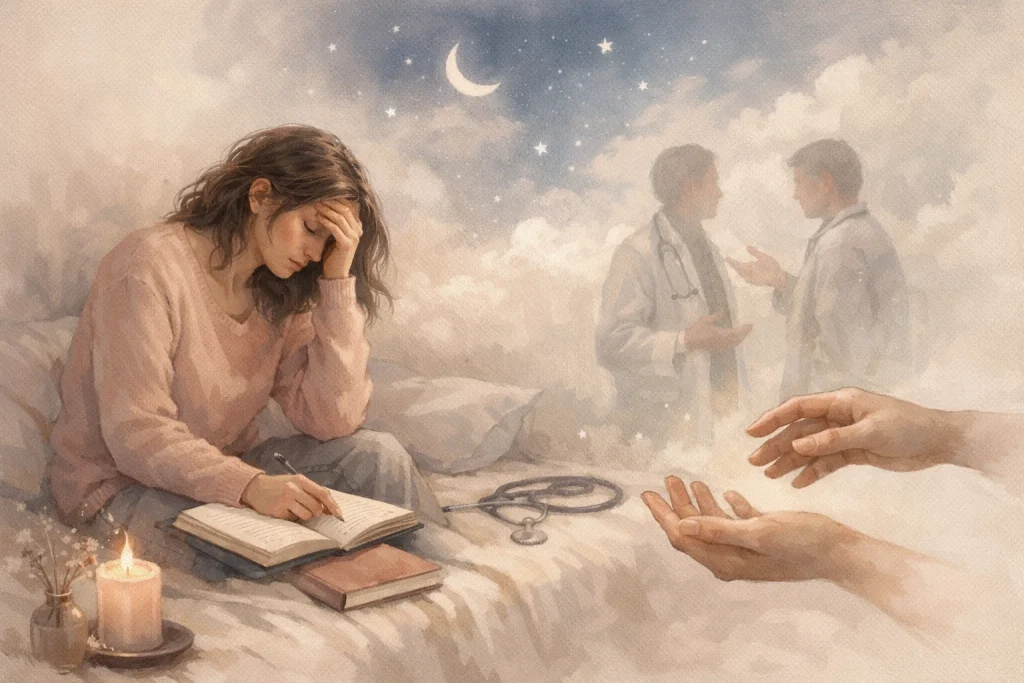
By my teens, the labels started stacking up. Anxiety. Depression. An eating disorder. Suicidal ideation. Chronic fatigue syndrome.
Some of those were real and I needed help with them. But every time I brought up the pain, it got filed under the same heading. The line I heard over and over was this:
“It’s your anxiety making you feel like that is happening to you. The pain is from you overthinking it.”
When you’re a teenager and every adult in the room says the pain is in your head, you start to believe them. Not because it makes sense, but because what else are you meant to do? They’re the doctors. You’re the kid who “overthinks”.
At 18, a spinal specialist looked at me and casually said I was “very hypermobile”. That was it. No follow up, no referral, no “hey, this might explain a few things”. Just a passing comment that I didn’t know to hang onto.
You may also like: I Walked on a Crushed Foot for Two Days. That’s Not Toughness, That’s Trauma.
My 20s: the job my body couldn’t do
In my 20s I worked as a vet nurse. I loved it. I also hurt all the time.
One day I reached for a surgical kit and tore the cartilage in my ribs. Just reaching. That’s the kind of thing that happens when your connective tissue doesn’t hold. Eventually a doctor told me to quit vet nursing and get a desk job.
Nobody asked why a woman in her 20s was tearing cartilage reaching for a tray. The answer was just to make my life smaller.
My 30s: the fast decline
In my early 30s, everything sped up. More pain, more fatigue, more things going wrong. And the answer from the doctors was still the same: anxiety and depression.
So I did the thing you’re not supposed to do. I went home and Googled it.
I typed in my whole list. Every diagnosis, every symptom, all of it together in one place. And for the first time, the pattern pointed somewhere: Ehlers-Danlos syndrome.
I took it to my GP. She looked at me and said, flatly, “You don’t have that.”
Something in me snapped. I said, “You’re not the one paying for it, I am. So refer me. And if it comes back that I don’t have it, you can say I told you so.”
She referred me.
Six months, over a thousand dollars, and one diagnosis
Seeing the genetic specialist was a process. Testing, my whole history, and a lot of questions. It took about six months from my first appointment to the diagnosis, and it cost me over a thousand dollars out of pocket.
Then, at 33: hypermobile Ehlers-Danlos syndrome. Confirmed.
I’d love to tell you it was pure relief. It was more like a million emotions at once.
Relief, because I finally had a reason for what I’d been suffering through every single day. Proof that I hadn’t made it up.
Anger, because it took this fucking long. Because nobody believed me. Because a specialist literally wrote “very hypermobile” when I was 18 and nobody joined the dots for another fifteen years.
And grief. Because EDS is genetic and degenerative. There was no fix waiting on the other side of the diagnosis. Just a name for it.
That grief didn’t stop. I’m 43 now, and each year my body changes and I have to grieve the body I used to have all over again. Nobody warns you about that part. You don’t grieve once. You grieve in instalments.
So yes, I went back to my GP and said, “I told you so. And I’m finding a new doctor.” And then I did.

What changed (and what didn’t)
The diagnosis changed a lot of practical things. How I move, how I do certain tasks, how I pace myself. It also eventually meant I had to stop working.
And I found a new GP who actually knows about EDS. More than that, she knows that I know my body. When I ask her to look at something, she doesn’t hesitate. She refers me. That one change has made more difference than I can explain.
She’s also the one who listened when new symptoms started showing up, the kind other people had been brushing off as “just your EDS” or “just tired”. Based on what I told her, she referred me to a neurologist, and that’s how I ended up with my FND diagnosis. That’s a story for another post. Even now, years later, the two of us are still working through certain symptoms and figuring out what’s connected to what. The difference is that now I’m working it out with someone, not fighting to be heard.
But here’s what didn’t change. I’d spent so long being told it was all in my head that a piece of paper couldn’t undo it.
EDS is a dynamic disability. Some days I’m okay. Some days I can barely move. On the okay days, people tell me it can’t be that bad. On the bad days, people tell me I’m faking it. So I’m stuck second guessing myself constantly. Am I really that sick? Am I exaggerating? Am I a fraud?
I have a genetic diagnosis from a specialist. I still ask myself that. At 43.
What being disbelieved does to your body
This is the part my training has helped me understand.
When the people who are supposed to help you keep telling you your pain isn’t real, it doesn’t just hurt your feelings. It teaches you something. It teaches you not to trust your own body. You learn to question every signal, play down every symptom, and walk into appointments already braced to be dismissed.
For me it landed on top of a childhood where the rules were already “I won’t be believed” and “stop talking about it”. The doctors just confirmed what I’d learned at home.
A lot of people call this medical gaslighting. Whatever you call it, my nervous system learned that a doctor’s office isn’t a safe place. That’s why, even now, I put off going unless I absolutely have to. That’s not me being difficult. That’s a body that remembers.
And that constant self-doubt? It’s not evidence that you’re making it up. It’s what happens when you’ve been told for years that your own experience doesn’t count.
You may also like: I Didn’t Know My Nervous System Was Stuck “On” Until I Locked Myself in a Cupboard
If you’re still waiting to be believed
I can’t diagnose you, and I’m not going to tell you what you have. But here’s what I’d say to the version of me sitting in that GP’s office at 15, or 25, or 32.
You know your body. You’ve lived in it every single day. That counts.
Put it all in one place. What finally cracked my case open was seeing every symptom and diagnosis written down together. Separately they looked like random bad luck. Together they made a pattern.
You’re allowed to ask for a referral. And you’re allowed to ask again if the answer is no.
You’re allowed to change doctors. You don’t owe anyone your loyalty if they won’t listen to you.
It’s not in your head. Even if it’s also affecting your head. Pain and anxiety can exist at the same time. One doesn’t cancel out the other.
Walking in prepared
I made my Doctor Appointment Prep Kit for exactly this. It helps you get your symptoms, history and questions on paper before you walk in, so you’re not trying to remember everything while someone looks at the clock and tells you it’s probably stress. It’s the thing I wish I’d had at 15.
Get the Doctor Appointment Prep Kit here
And if appointments send your nervous system through the roof (same), my free 60 Second Nervous System Reset Cards are quick tools for the car park before and after. Signing up also gets you onto my email list.
One more thing. Somewhere along the way I was told I’d never have kids. A year after my diagnosis, I was pregnant with my daughter. That’s a whole other story about not being listened to, and I’ll tell it properly another time.
For now, I’d love to know: how long did it take for someone to believe you? Tell me in the comments or reply to one of my emails. I read every one.
Disclaimer: This blog shares my lived experience and what I’m learning through my trauma healing training. It’s for education and connection, not medical or psychological advice, and it isn’t a substitute for care from a qualified health professional. If you’re in crisis, please contact Lifeline on 13 11 14 or emergency services on 000. This post may contain affiliate links that earn me a small commission at no extra cost to you. See my Disclaimer for more information.
If this hits you hard….
You’re exactly who I write for. You don’t have to go through this alone.
- Download my FREE 60 Second Nervous System Reset Cards
- Join our newsletter – fill out the form below
- Save this post on Pinterest so you can return to it on tough days 👉