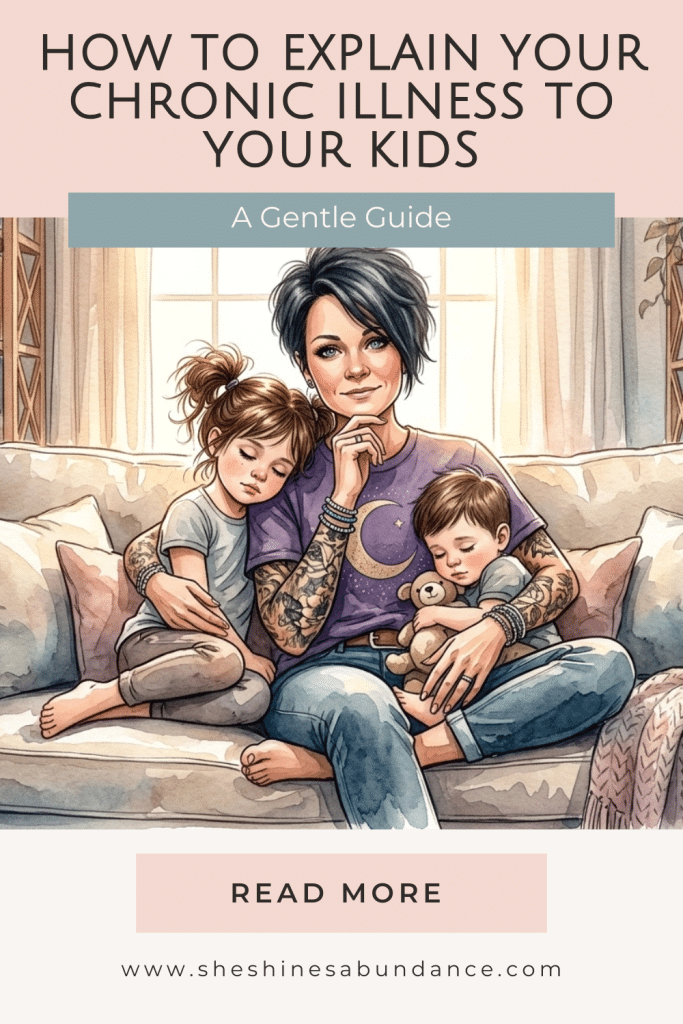
I remember the exact moment the guilt nearly swallowed me whole. It was a Tuesday afternoon, and my body felt like it was being crushed by a lead weight. My FND was flaring, my joints were screaming, and all my six-year-old wanted was for me to get on the floor and build a Lego castle. I had to say no for the tenth time that day. I saw his little face fall, that flicker of “Is it me?” in his eyes, and I realized that explaining chronic illness to kids isn’t just about giving them facts, it’s about protecting their hearts from the stories they tell themselves when we’re too sick to show up the way we want to.
Disclaimer: I’m not a doctor or therapist; I share trauma-aware insights from lived experience for educational use. Please consult your healthcare team before making changes. This post may contain affiliate links that earn me a small commission at no extra cost to you.
The Reality of Parenting with an Invisible Illness
Parenting is bloody hard even when your body actually works. When you’re navigating chronic illness, it feels like you’re trying to run a marathon through waist-deep mud while everyone else is on a paved track. You worry they’ll grow up remembering a mum who was always on the couch. You worry they’ll feel unloved or, worse, like they have to take care of you.
And then there’s the guilt that hits in the chest. The raw kind. The kind that whispers your kids are “stuck at home” because of you. That they’re “suffering” because your body can’t do what other mums seem to do without thinking. That guilt is brutal. It’s not rational, but it is real, and pretending otherwise is bullshit.
But here’s the truth: your kids don’t need a “perfect” parent. They need a real one. They need to see that it’s okay to have limitations and that a person’s worth isn’t tied to how much they can do. Explaining chronic illness to kids is the first step in building a home where “rest” isn’t a dirty word, but a necessary part of a beautiful, messy life.
Start with Radical Honesty (But Keep it Simple)
Kids are like little emotional sponges. They know when something is off. If you try to hide your pain or pretend you’re fine when you’re clearly not, they’ll sense the disconnect. Usually, they’ll fill that gap with their own imagination, and their imagination is often much scarier than the truth.
When explaining chronic illness to kids, avoid the medical jargon. They don’t need to know the ins and outs of your nervous system or the technicalities of a flare-up. They need a framework they can touch and feel.
I tell my kids things like, “Mummy is feeling a bit funny in the head today” when the brain fog is bad. Or, “Mummy is in pain so can’t do much today.” Sometimes I’ll say, “Mummy’s body has a bit of a glitch today,” or, “My internal battery is running on 5%.” It validates what they are seeing without making them feel responsible for fixing it. It tells them, “You aren’t seeing things. Mummy is struggling, but it’s not because of you, and it’s not your job to fix.”

Using the “Spoon Theory” or the “Energy Battery”
One of the most helpful tools in explaining chronic illness to kids is the Spoon Theory. If you haven’t heard of it, it’s a simple metaphor where “spoons” represent units of energy. Most people start the day with an unlimited drawer of spoons. People with chronic illness? We get maybe five or six.
For younger kids, I like the Energy Battery idea.
- Green: I can play, go to the park, and do all the things.
- Yellow: I can read stories on the couch, but I can’t jump on the trampoline.
- Red: I need quiet time and soft lights. I can still cuddle, but my body needs to rest.
When you use a visual scale, it takes the guesswork out of their day. They stop asking “Can we go to the park?” because they can look at your “battery” (or your face) and understand where you’re at. It teaches them empathy and pacing, skills that will serve them for the rest of their lives.
Addressing the “Is it My Fault?” Fear
The most important thing to repeat, over and over and over, is that your illness is not their fault. Kids are naturally ego-centric; they often think the world revolves around them, which means they also think they cause things they don’t understand.
When you are explaining chronic illness to kids, use these exact words:
“My body is having a hard time, but my heart is still full of love for you. You didn’t do anything to make me feel this way, and nothing you do can ‘fix’ it. Your only job is to be a kid.”
And this matters just as much when you’re talking about boundaries. Even if mummy is sick, it is not your kids’ responsibility to look after you. They can be kind. They can be caring. They can grab a blanket if they want to help. But they are not your carers, and they should never feel like the grown-up in the room.
If you’re having a particularly rough day and the brain fog is making you irritable, it’s okay to apologize later. “I’m sorry I was snappy earlier. My pain was very high and I didn’t have many ‘patience spoons’ left. It wasn’t about you.” That’s not being a bad parent; that’s being a human parent.
Validating Their Feelings (Even the Messy Ones)
It’s damn hard to hear your child say, “I hate your sickness!” or “I wish you weren’t always tired.” Your instinct might be to feel hurt or to get defensive. Don’t.
They are allowed to grieve the “normal” life they see other kids having. They are allowed to be frustrated. When you validate their anger, you’re telling them that their feelings are safe with you. You might say, “I know, I hate it too sometimes. It’s okay to be sad that we can’t go to the party today. Let’s be sad together for five minutes, and then we’ll find a ‘couch activity’ we can do instead.”
This is where my 60 Second Nervous System Reset Cards come in handy for both of you. When the frustration in the house is rising, picking a card together can help shift the energy from “this is a disaster” to “we can handle this moment.”

Creating a “Couch Culture”
If you can’t run around outside, bring the world to the couch. Some of my best memories with my kids happen when I’m horizontal. We have “Couch Picnics,” we do “Sticker Books,” we watch “Nature Documentaries” and talk about the animals. Sometimes it’s Xbox mirroring, where I’m just in the room while he plays and that closeness still counts. Sometimes it’s those quiet, low-pressure check-ins in my daughter’s room, where I sit for a minute, have a small chat, and remind her I’m still here even if I’m running on fumes.
Explaining chronic illness to kids involves showing them that connection isn’t dependent on physical activity. Presence is more important than performance. Your kids won’t remember that you didn’t take them to the park every day; they’ll remember that you were the safe harbour they could always crawl into when they needed a cuddle.
The Most Empathetic Humans You’ll Ever Meet
One thing illness has shown me, in the most unexpected way, is just how deeply kids can care. Not in a they should have to way. Not in a parentified, heavy, unhealthy way. I mean in a quiet human way that will absolutely undo you.
My daughter will check the shower door if I’ve gone quiet in there for too long. Not because I asked her to. She just notices. Both of my kids will randomly offer a massage, bring help I didn’t ask for, or do some small kind thing that makes me want to cry into my tea. Even with their own challenges, even with all the ways this life is hard for them too, they still think of other people.
That doesn’t mean the illness is a gift. I’m not going to sugar-coat it like that. But it does mean that growing up around struggle can build empathy in ways the world bloody needs more of. Explaining chronic illness to kids isn’t only about helping them understand pain. Sometimes it also shows you the tenderness that was already in them.
You Are Not Broken
If you take nothing else away from this, please hear me: You are not a burden to your children. You are teaching them resilience. You are teaching them that people are valuable even when they are resting. You are teaching them how to love through the hard stuff.
Parenting with a chronic illness is a different kind of strength. It’s a quiet, gritty, stubborn kind of love that shows up even when the body wants to quit. You’re doing a bloody good job.

What’s the hardest question your child has ever asked you about your illness? Let’s talk about it in the comments. We’re in this together.
I shared a much deeper, more personal look at this over on Substack – including the parts that were too raw for the blog. You can read the “Unfiltered Version” HERE.

If this hits you hard….
You’re exactly who I write for. You don’t have to go through this alone.
- Download my FREE 60 Second Nervous System Reset Cards
- Join our newsletter – fill out the form below
- Join us on Substack for real, day-to-day life updates and get new blog posts sent straight to your inbox first.
- Save this post on Pinterest so you can return to it on tough days 👉