Nobody tells you this part: chronic illness turns your life into constant negotiation. With your body. With your calendar. With other people’s expectations. With your own inner critic.
And if you’ve ever wished you had a simple way to explain why you can’t “just push through”…this is spoon theory explained in a way that actually honours what you’re living with.
I’m Briony (She Shines Abundance). I live with chronic illness (FND, EDS, POTS, MCAS) and I support women in the post-survival stage of trauma and illness – the stage where you’re alive, but you’re exhausted, grieving, and trying to find a gentle way to live that doesn’t cost you your health.
What is spoon theory (and why it hits so hard)?
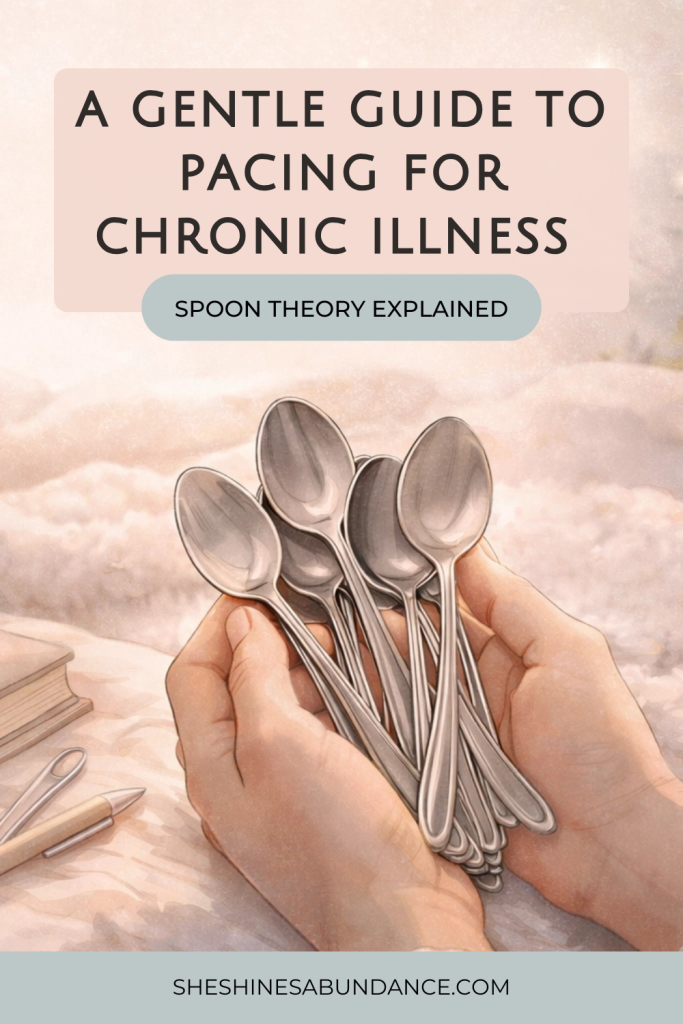
If you’re asking what is spoon theory, here’s the simplest explanation:
- A “spoon” = one unit of energy
- You wake up with a certain number of spoons
- Everything you do costs spoons
- When you run out, you can’t just “try harder” – you crash, flare, or shut down
Spoon Theory was created by Christine Miserandino in 2003. She used spoons at a café to show a friend what it’s like to live with lupus – and it went viral in the chronic illness community because it finally gave us language for the invisible stuff.
You can read Christine’s original essay here: The Spoon Theory.
Why spoon theory explained matters (especially in the post-survival phase)
Spoon Theory isn’t just a cute metaphor. It’s a boundary tool. It’s validation. It’s a way to stop arguing with yourself.
Because when you’re living with chronic illness, you’re not dealing with “tired”. You’re dealing with:
- limited energy
- unpredictable symptoms
- recovery time nobody else sees
- the emotional weight of constantly adjusting your life
That’s where spoonie energy management becomes less about optimisation…and more about protecting your basic ability to function.

The emotional tax of chronic illness (the spoon cost nobody validates)
Most people understand physical fatigue. Sort of. But the emotional tax? That’s the part that quietly eats your life.
Here’s what costs spoons that people rarely count:
1) The grief layer
Not dramatic grief. The slow, repetitive kind.
- grieving the version of you who could do things “normally”
- grieving the future you planned for
- grieving friendships that faded because you couldn’t keep up
Sometimes you’re not exhausted because you did too much.
You’re exhausted because you’re carrying loss.
You’re allowed to feel that. You’re not ungrateful. You’re human.
2) The “prove you’re sick” layer
If you’ve ever rehearsed what to say to a doctor…that’s spoons.
- documenting symptoms
- chasing referrals
- preparing to be dismissed (again)
- advocating while brain fogged
This is labour. It’s exhausting. And it’s unfair.
3) The masking layer
The smiling. The “I’m fine”. The downplaying. The pretending you didn’t just spend three spoons on standing in the kitchen.
Masking is a survival skill.
And it’s expensive.
Spoon theory explained in real life: how many spoons do things actually cost?
This part is different for everyone – and it changes day to day. But it can be powerful to name it.
Here’s an example spoon budget (yours will be different):
- Shower (especially washing hair): 2–4 spoons
- Preparing food: 1–3 spoons
- A phone call: 1–2 spoons
- Leaving the house: 2–5 spoons
- Social time (even with people you love): 2–6 spoons
- A medical appointment: 4–8 spoons (including the emotional comedown)
And then there are “bonus costs” like:
- pain
- sensory overload
- temperature changes
- adrenaline spikes
- nausea
- the after-effects of pushing
This is why “simple” tasks aren’t simple. It’s not you being difficult. It’s your body doing extra behind-the-scenes work.
Chronic illness pacing: the gentle skill that changes everything
Chronic illness pacing is basically the practical side of spoon theory explained. It’s how you spend spoons on purpose, instead of accidentally blowing them all by lunchtime.
And yes, pacing is hard. Especially when you’ve been praised your whole life for pushing through.
Here’s what doesn’t work (and you’re not failing for trying it):
- waiting until you crash, then resting
- doing “all the things” on a good day to make up for bad days
- comparing your capacity to past-you or healthy people
- calling yourself lazy when symptoms win
Here’s what helps instead.
1) Find your “baseline” (not your best day)
Your baseline is the amount you can do without a major payback.
A simple way to start:
- Pick a typical week (not your best week)
- Notice what consistently triggers a flare or crash
- Reduce that by 10–20% for two weeks
- See if your symptoms stabilise even slightly
That’s pacing. Not perfection. Stabilisation.
2) Use the “stop sign” rule
If you’re at the point of thinking, “I can probably push through this”…that’s your stop sign.
Try:
- sit down
- drink water
- eat something small
- change position
- do 60 seconds of nervous system support (more on that below)
3) Plan for recovery (not just the activity)
If an outing costs 5 spoons, recovery might cost 5 more.
Build recovery in before you need it:
- a rest block the next day
- a low-demand dinner plan
- no phone calls after appointments
- one “main thing” per day
That’s spoonie energy management that respects reality.
Pacing for chronic fatigue: how to pace when you’re already empty
If you’re living with ME/CFS, post-viral fatigue, long COVID fatigue, or fatigue as part of other conditions, standard advice often feels insulting.
“Just exercise more.”
“Try a morning routine.”
Cool. And you’ll also be in bed for a week.
Pacing for chronic fatigue often means thinking smaller than you want to. Not because you’re weak – because you’re wise.
Try these micro-pacing ideas:
- sit whenever you can (yes, even while brushing teeth)
- halve the task (wipe the bench, leave the floor)
- rest before you feel tired (annoying, but effective)
- alternate body positions (lying → sitting → standing)
- use timers (5 minutes on, 10 minutes off)
If the word “rest” triggers your inner critic, call it recovery. Or symptom management. Or medical care. Because that’s what it is.

Condition-specific examples: POTS, FND, EDS, MCAS (spoons look different here)
One reason spoon theory explained is so helpful is because it allows for nuance. Your spoons don’t just run out from “doing too much”. They get stolen by symptoms.
Here are some examples (not medical advice – just lived-experience style validation).
POTS (Postural Orthostatic Tachycardia Syndrome)
With POTS, upright posture can be a spoon thief.
- standing in a queue can cost more than walking
- showering can feel like a cardio workout
- heat can wipe you out fast
- your body may spend spoons just keeping your heart rate and blood flow stable
Pacing tip: sit for tasks, break showers into stages, and schedule upright activities earlier (if mornings are better for you).
FND (Functional Neurological Disorder)
FND often has a big nervous system component – meaning your brain and body can glitch under stress, sensory input, fatigue, or overload.
- symptoms can spike after emotional stress
- concentration can trigger neurological fatigue
- overstimulation can lead to shutdowns, tremors, weakness, speech issues, or dissociation
Pacing tip: shorten “thinking tasks”, add sensory breaks, and plan decompression after anything high-stimulation (appointments, shops, school events).
EDS (Ehlers-Danlos Syndromes / hypermobility)
With EDS, your body may use extra spoons for stabilisation and pain management.
- joints subluxing/aching steals energy
- sitting “normally” can still cost spoons if muscles are holding you together
- injuries happen easily, which adds more recovery time
Pacing tip: prioritise joint support, reduce repetitive tasks, and treat pain days as legitimate low-spoon days (because they are).
MCAS (Mast Cell Activation Syndrome)
MCAS can make your body reactive in unpredictable ways.
- food reactions, smells, temperature, stress, medications – all potential spoon drains
- flare-ups can involve fatigue, GI symptoms, flushing, brain fog, and anxiety-like sensations
- hypervigilance around triggers is its own emotional load
Pacing tip: simplify meals, minimise exposure to known triggers, and factor in the spoon cost of “being on alert”.
If you’re nodding reading this, I want you to hear it clearly: you’re not failing at life. Your body is doing hard work.
Using “spoon language” with friends and family (without a big speech)
Sometimes the hardest part isn’t pacing.
It’s other people’s reactions.
“Spoons” can be a gentle way to communicate without needing to explain your whole medical history.
Here are a few scripts you can steal.
Quick, everyday scripts
- “I’ve got about 3 spoons left today, so I can either come for an hour or do the errand – not both.”
- “I want to say yes, but I’m low on spoons. Can we do a quieter version?”
- “If I do that today, I’ll be in spoon debt tomorrow. I need to choose future-me.”
- “I’m not cancelling because I don’t care. I’m cancelling because I’m out of capacity.”
If someone pushes
- “Pushing through makes my symptoms worse. I’m pacing so I can stay more stable.”
- “I know it’s hard to understand. I’m doing what my body requires.”
- “I’m not asking you to fix it. I just need you to believe me.”
You don’t owe anyone a perfect explanation.
You’re allowed to keep it simple.

Spoon debt and internalised ableism: the shame layer we have to talk about
Spoon debt is what happens when you borrow spoons from tomorrow (or next week) to survive today.
Sometimes it’s unavoidable. Parenting. Work. Medical stuff. Basic life admin.
But there’s also a sneaky reason we fall into spoon debt: internalised ableism.
That voice that says:
- “Other people do more.”
- “You should be able to handle this.”
- “You’re just not trying hard enough.”
- “Rest is lazy.”
That voice is not truth.
It’s conditioning.
How to climb out of spoon debt (gently, not perfectly)
If you’re in a crash cycle, try this like a soft reset:
- Name the debt
- “I overspent. My body is collecting.”
- No shame. Just reality.
- Cut one non-essential demand
- one errand
- one conversation
- one expectation you’re carrying out of guilt
- Add one stabiliser
Pick one tiny thing that supports your system:
- electrolytes/water
- a protein snack
- a 10-minute lie down with legs elevated (POTS friends, you get it)
- a heat pack
- a quiet room
- a shower chair
- noise-cancelling headphones
- Practice “good enough” pacing
Not perfect pacing. Not aesthetic pacing. The kind that keeps you out of the worst of it.
You’re allowed to need accommodations.
You’re allowed to live differently.
You’re allowed to stop proving yourself.
A gentle support you can use on low-spoon days: 60-Second Reset Cards
When you’re already depleted, big routines can feel like a joke. You don’t need another “wellness plan” that asks you to perform healing.
That’s why I created my free 60-Second Nervous System Reset Cards – tiny, doable practices for the moments you’re dysregulated, overwhelmed, or flat-out out of spoons.
They’re designed for real life:
- from bed
- from the couch
- between school pick-up and dinner
- before/after appointments
- in the middle of a flare when your brain can’t do “steps”
You can grab them here: Free 60-Second Reset Cards
And if you’re new around here, you might also like my About page to see what I’m about and why I care so much about gentle, honest healing.
Takeaway: spoon theory explained in one line (and what to do next)
Spoon theory explained: you have a limited energy budget, and pacing is how you spend it in a way that protects your health and your life.
If you take nothing else from this post, take this:
- You’re not lazy.
- You’re not broken.
- You’re adapting to a reality other people don’t have to live inside.
Start small:
- track your spoons for one day
- choose one task to make easier
- practise one sentence of spoon language
- take one 60-second reset
That counts. It all counts.

Related reading: If you’re also navigating the emotional weight of chronic illness, you might find comfort in Grief: Losing the Life You Thought You’d Have or How to Find Hope When You Feel Hopeless.
If this hits you hard….
You’re exactly who I write for. You don’t have to grieve this alone.
- Download my FREE 60 Second Nervous System Reset Cards
- Join our newsletter – fill out the form below
- Save this post on Pinterest so you can return to it on tough days 👉