Content note: this post talks about chronic pain, flares and panic. Please look after yourself while you read.
I made a deck of cards for flare days. Ninety of them. Grounding prompts, affirmations, low energy resets, emergency cards.
And it would be really easy to write a post where I pull a card, take a breath, and float off into a calm afternoon. That’s not what happens. So this is the honest version: what a flare actually looks like for me, how I use the deck when I’m in it, and what it does and doesn’t fix.
Quick note first: I’m sharing my lived experience and what I’m learning as a Level 2 Trauma Healing Practitioner working towards Level 3. I’m not a doctor and this isn’t medical advice. If your symptoms are new or getting worse, please see a health professional.
What a flare actually looks like for me
I live with FND, hEDS, MCAS, dysautonomia, chronic pain, autism, ADHD and CPTSD. So “flare” can mean a lot of things. But on a bad one, it usually looks something like this.
The pain is louder than usual, and it’s everywhere. My shoulder has slipped in and out of joint overnight. The ticks and spasms ramp up. My hands won’t grip, so I drop things, and my feet drag so I trip over nothing. Heat makes all of it worse.
Then my brain joins in. Fog. Catastrophising. My heart rate goes up. Every small thing feels enormous, and I feel like I’m going to explode.
And the kids still need to get to school. The animals still need feeding. Whatever energy I’ve got goes to them first, because it always does. Everything else waits, including me.
This is the bit people don’t see. I can look completely fine from the outside while my whole body is screaming.
Why I can’t think my way out of it
When I’m in a flare, people (and the internet) love to tell me to “think positive” or “just breathe”.
I genuinely cannot see the positive in that moment. And if one more person tells me to just breathe, I might throw the phone. It’s not that breathing is bad. It’s that being told what to do by someone who isn’t in my body feels like the opposite of help. And after someone has been aggressive, breathing does nothing for me at all. My whole body shakes, sometimes for half an hour after it’s over, and no amount of slow breaths touches that.
Here’s what my training has helped me understand about why.
When your nervous system decides you’re under threat, and pain plus panic plus overwhelm absolutely counts, it shifts into survival mode. The parts of your brain that plan, weigh up options and make good decisions become a lot harder to reach. Your body is busy trying to keep you safe. It is not interested in a thoughtful pros and cons list. In my training this gets talked about as your window of tolerance: the zone where you can feel things and still think. A flare shoves me right out of it.
So in a flare, the question “what would help right now?” is almost impossible to answer. I know dozens of tools. I can’t remember a single one. Add ADHD on top, and I can’t stick with a long practice even on a good day, let alone a bad one.
That’s the whole reason the deck exists. I needed the decision already made for me, by a calmer version of me, before the flare hit.
How I actually use the deck in a flare
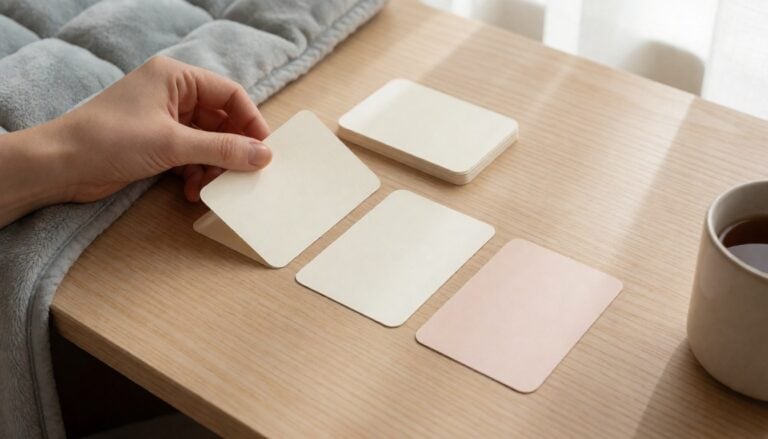
It lives where I can reach it. My deck sits on my office desk. I printed it on cardstock and rounded the corners with a corner punch, so it feels like a real deck of cards in my hands, not a pile of paper. That matters more than it sounds. If I have to go looking for it, I won’t. A flare is not the time for a scavenger hunt.
I pull three grounding cards. That’s my usual. Not the whole deck, not a reading, just three grounding prompts. Grounding is what I need most when my body’s gone haywire, because it pulls me back into the room instead of into the spiral in my head.
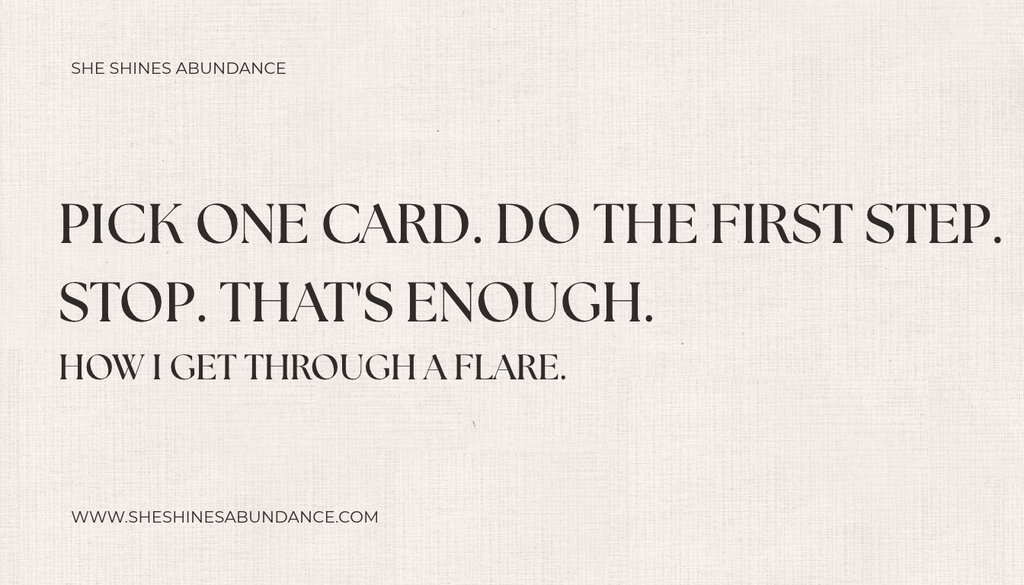
I only do the first step of each one. The deck’s rule is: pick one card, do the first step, stop. That’s enough. I’ve bent it to three cards because that’s what works for me, but I keep the first step bit. One step per card. Because my ADHD brain will happily abandon anything that looks like a five-part plan.
Some of the grounding prompts are tiny on purpose. One of them just says: “Take one slow breath. Not perfect, just slow.” And yes, I know I just complained about being told to breathe. The difference is that this one doesn’t ask me to calm down or fix anything. It asks for one breath, and it tells me it doesn’t have to be good. On a pain flare, I can do that. (After aggression, I skip it and pull another card. That’s allowed too.)
Then I read an affirmation, even if I don’t believe it yet. The one that gets me every time is “My body is not the enemy.”
After a lifetime of being told my pain was in my head, after years of fighting my own body just to get through a school run, that line is hard to read. Some days I don’t believe it at all. I read it anyway. I’m not trying to force a feeling. I’m just giving my nervous system a different sentence to hear than the one it’s been hearing for decades.
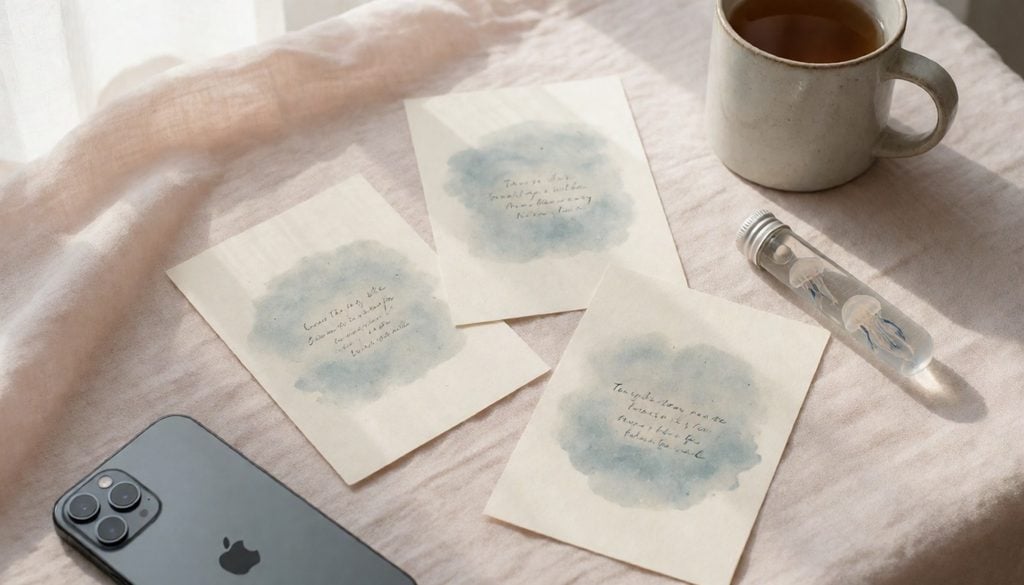
I stack it with the small stuff that already works. The deck isn’t my only tool. I’m autistic, so a lot of what helps me is sensory. I’ll put on sounds that calm me down. I’ll run my hands under cold water. I’ll walk barefoot on the grass, or get under my weighted blanket. I’ll watch my sensory tube with the little jellyfish floating in it. Or I’ll text a friend and say “bad day” so I’m not holding it on my own.
None of these are big. Together they’re a few small “you’re safe right now” messages to a body that doesn’t believe it.
What it doesn’t do
I want to be really clear here, because I hate when wellness stuff overpromises.
The deck doesn’t stop a flare. My shoulder is still out. The ticks are still going. The pain is still there. No card has ever fixed a dislocated joint, and if someone tells you a deck of cards will heal your chronic illness, run.
What it changes is the bit around the flare. The panic about the pain. The spiral of “this will never end”. The feeling of being completely alone with it and not knowing what to do. It gives me one thing to do when I can’t think of anything, and that one thing is often enough to stop a bad hour turning into a bad day.
And honestly? Some days I don’t pick it up at all. I made this thing and there are still days I can’t make myself use it. That used to make me feel like a total fraud. Who am I to sell a regulation tool when I can’t always regulate?
But I’ve come to think that’s exactly why it’s built the way it is. It’s not made for the version of me who has her shit together. It’s made for the version who’s at her absolute limit and can only manage one step. If she manages one step, that counts.
If you want to build your own flare plan
You don’t need my deck to do this. Here’s what I’ve learnt about what makes a flare tool actually usable:
- Decide before, not during. Write down what helps on a good day, so a flare-day you doesn’t have to remember.
- Sort it by how you feel. “Panicking”, “shut down”, “exhausted” and “overstimulated” need different things. Don’t make yourself choose from one big pile.
- Make it reachable. Mine’s on my office desk. Bedside, bench, or a photo album on your phone works too. Wherever you’ll actually be.
- One step only. If it needs more than one step to start, it won’t get started.
- Pair it with people. A quick “bad day” text to someone safe counts as a tool.
The deck, if you want it
The Calm in Chaos Card Deck is the thing I made for days like this. Ninety printable cards: grounding prompts, soothing affirmations, trauma-aware reflection questions, low energy resets for flare days, and emergency cards for when you’re panicking or shutting down. You can print it or save the phone-friendly version to your camera roll, so it’s with you wherever the flare finds you. It’s $19 AUD.
If you’d rather have something to read on a better day that walks you through it more slowly, my Nervous System Reset Guide has 14 low energy resets for bringing a stuck-on system back down.
And if you just want to start small, my free 60 Second Nervous System Reset Cards are the lighter version. Signing up also gets you onto my email list.
I’d love to know: what’s the one thing you reach for in a flare? Tell me in the comments or reply to one of my emails. I read every one.
Disclaimer: This post shares my lived experience and what I’m learning through my trauma healing training. It’s for education and connection, not medical or psychological advice, and it isn’t a substitute for care from a qualified health professional. Grounding tools can help with distress, but they don’t treat the underlying condition. If you have new, worsening or worrying symptoms, please see a doctor, and if one won’t listen, please see another. If you’re struggling or in crisis, contact Lifeline on 13 11 14 or emergency services on 000. See my Disclaimer for more information.
If this hits you hard….
You’re exactly who I write for. You don’t have to go through this alone.
- Download my FREE 60 Second Nervous System Reset Cards
- Join our newsletter – fill out the form below
- Save this post on Pinterest so you can return to it on tough days 👉