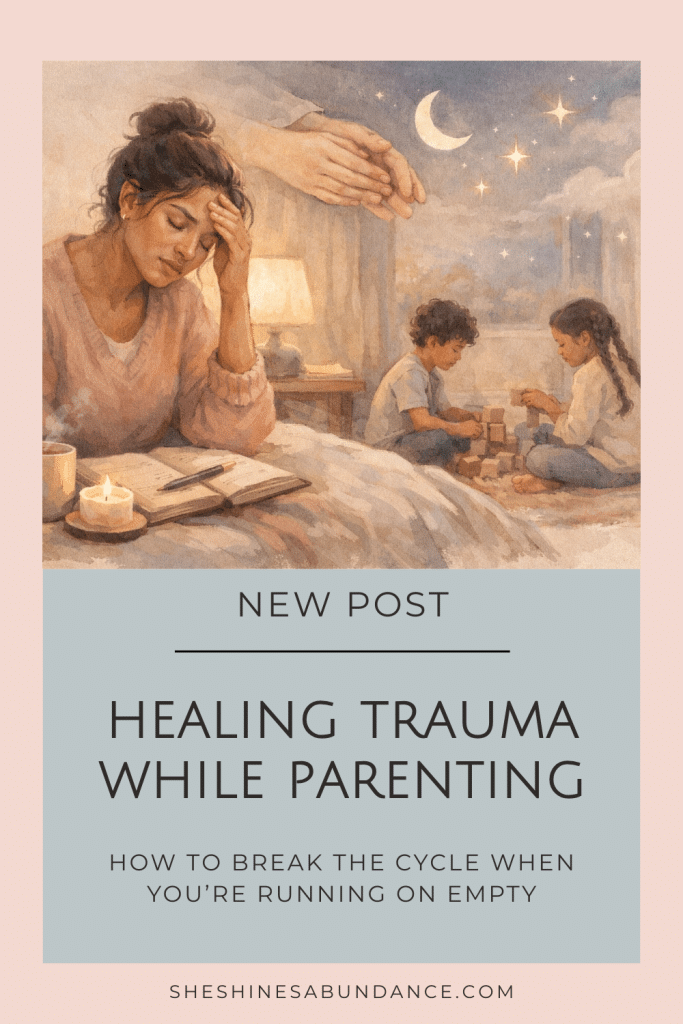
Let’s be honest: healing trauma while parenting is like trying to rebuild a house while living in it during a storm. You’re patching holes in your own foundation whilst simultaneously building a safe structure for your kids. And some days? Some days you’re just trying not to collapse under the weight of it all.
Nobody tells you this part. Nobody warns you that the moment you become a parent, every unhealed wound from your own childhood will come roaring to the surface. That your toddler’s tantrum will send you straight back to being five years old, terrified and small. That you’ll be mid-sentence, repeating the exact words your own parents said, and you’ll freeze: horrified: because you swore you’d never say those things.
Here’s what I need you to hear before we go any further: You’re not failing. The fact that you’re here, reading this, questioning your patterns and trying to do better? That’s already breaking the cycle. That awareness: that desperate desire to parent differently even when you’re running on fumes: is the most powerful tool you have.
The Weight You’re Carrying (And Why It’s So Damn Heavy)
You’re not just parenting. You’re simultaneously:
- Processing your own childhood trauma
- Learning emotional regulation you were never taught
- Breaking patterns that have existed for generations
- Showing up for your kids’ big feelings when yours were never allowed
- Trying to give them security you never had
- Doing all of this while likely dealing with chronic illness, neurodivergence, or both
This isn’t regular parenting. This is healing and parenting at the same time, and it’s exhausting because you’re doing the work of two full-time jobs with the energy reserves of someone who’s been running on empty for years.
The research backs this up: breaking intergenerational trauma requires immense self-compassion and support, precisely because you’re healing whilst actively parenting. You cannot pour from an empty cup, yet somehow, you’re expected to keep pouring.

Why “Good Enough” Parenting Is Actually Brilliant Parenting
Here’s the truth most parenting advice won’t tell you: Perfect parenting doesn’t exist, and chasing it will destroy you.
The concept of “good enough” parenting isn’t about lowering your standards: it’s about understanding that your kids don’t need perfection. They need presence. They need repair. They need to see you as human.
When you’re healing trauma while parenting, “good enough” means:
- You lose your temper sometimes, but you come back and repair
- You don’t always have the energy for elaborate activities, but you’re emotionally available when it matters
- You mess up, apologise, and show them what accountability looks like
- You take breaks to regulate your nervous system instead of pushing through until you explode
Your kids don’t need a parent who never struggles. They need a parent who shows them how to be human: including the messy, imperfect parts.
I’ve been that parent who’s snapped at my kids over something tiny because I was triggered, not by them, but by something from decades ago. The shame that follows is brutal. But here’s what I’ve learnt: the repair is where the real teaching happens. When you come back, own your reaction, and explain (in age-appropriate ways) that you were overwhelmed: not because of them: you’re teaching emotional responsibility your own parents likely never modelled.
When Triggers Hit Mid-Tantrum: What Actually Helps
Let’s talk about the hardest moment in trauma-informed parenting: when your child’s behaviour sends you straight into fight-or-flight mode.
Your four-year-old is screaming because you cut their sandwich wrong. Your nervous system hears danger. Your body floods with adrenaline. Suddenly, you’re not a 30-something parent: you’re a terrified child being screamed at, and every cell in your body is screaming “make it stop.”
This is where gentle parenting advice often falls apart. You’re supposed to stay calm, get down to their level, validate their feelings. But how the hell do you do that when your own nervous system is convinced you’re under attack?
The “Pause and Breathe” Method (That Actually Works)
Here’s what helps when you’re triggered mid-chaos:
1. Name what’s happening internally.
Silently: “I’m triggered. This is my nervous system, not the current situation.”
2. Create physical space if needed.
You’re allowed to say: “I need one minute to calm my body. I’ll be right back.” Step into another room. Splash cold water on your face. Press your feet into the ground.
3. Use a quick nervous system reset.
One deep breath where you exhale longer than you inhale. Touch something cold. Look at something far away to shift your focus.
4. Return and co-regulate.
You don’t need to be perfectly calm. You need to be regulated enough to help them regulate. Your presence: not perfection: is what matters.
The concept of “Regulate, Relate, Reason” is crucial here. First, you regulate your own nervous system. Then, you relate to your child through connection. Finally: and only once they’re calmer: you can reason or problem-solve together.

Teaching Resilience by Showing Your Work
Here’s something that changed everything for me: Your kids don’t need you to hide your healing. They need to see it.
When you’re healing trauma while parenting, you’re inadvertently teaching your children:
- That emotions are normal and manageable
- That adults can make mistakes and repair them
- That asking for help is strength, not weakness
- That healing is possible, even when it’s hard
- That they’re allowed to have needs and boundaries
Every time you pause to regulate yourself, you’re showing them self-care in action. Every time you apologise for yelling, you’re modelling accountability. Every time you say, “Mummy’s feeling overwhelmed and needs a quiet moment,” you’re teaching them that emotions are information, not character flaws.
This is the opposite of what many of us learnt growing up. We learnt to hide struggles, to “stay strong,” to never show weakness. But that pattern is exactly what we’re trying to break.
Your children don’t need to know the details of your trauma. But they can witness your commitment to healing. They can see you taking care of yourself. They can learn that it’s okay to not be okay: and that you can still function, still love them, still show up, even on hard days.
Practical Tools for Healing Trauma While Parenting
When you’re depleted, you need strategies that require minimum energy but maximum impact.
Build Predictable Routines
Routines reduce the cognitive load for both you and your child. When bedtime follows the same pattern every night, you don’t need to make decisions: you just need to follow the script. This creates security for them and preserves your limited energy.
Use “Secure Interactions” Strategically
Research shows that small moments of attunement: a hug when they’re upset, validating their feelings, eye contact during routine tasks: activate your child’s social engagement system linked to safety and learning. These tiny moments compound over time without exhausting you.
You don’t need to be “on” all day. You need consistent moments of genuine connection.
Accept “Attuned Enough”
Attunement doesn’t mean perfect availability. It means responding to your child’s emotional cues with understanding. You can be present without being perfect.
Some days, “attuned enough” looks like:
- Acknowledging their feelings even if you can’t fix the problem
- Sitting with them quietly instead of offering elaborate solutions
- Saying “I see you’re upset” when you don’t have energy for more
Lower the Bar on Activities
Your kids don’t need Pinterest-worthy crafts or educational activities every day. They need you regulated more than they need you entertained.
Screen time while you rest isn’t failure: it’s survival. Cereal for dinner isn’t neglect: it’s accepting your limitations. Saying “not today” to requests isn’t cruel: it’s modelling boundaries.

The Mom Guilt Is Lying to You
Let’s address the elephant in the room: the guilt.
The guilt that whispers you’re damaging them. That you’re not doing enough. That other parents manage just fine, so why can’t you?
That guilt is lying.
Other parents aren’t healing decades of trauma while simultaneously raising children. Other parents weren’t taught that their emotions were dangerous or that their needs were burdens. Other parents might have secure attachment, stable nervous systems, and supportive childhoods to draw from.
You’re doing something incredibly brave: you’re healing and parenting at the same time. You’re breaking cycles that have existed for generations. You’re teaching your children emotional skills you’re only just learning yourself.
Does it look messy? Yes. Will you make mistakes? Absolutely. But here’s what matters: you’re trying. You’re aware. You’re committed to doing better than was done to you.
That’s not just good enough: that’s remarkable.
Seeking Support Isn’t Optional: It’s Essential
Here’s what took me too long to learn: you cannot break intergenerational trauma alone.
Therapy, parenting communities, personal reflection: these aren’t luxuries. They’re necessities. You need space to process your own trauma so it doesn’t unconsciously shape your parenting.
This might look like:
- Individual therapy focused on your childhood experiences
- Parenting support groups (online or in-person)
- Resources on trauma-informed parenting
- Nervous system regulation tools that help you stay grounded
- Trusted friends who understand what you’re navigating
You can’t heal in isolation. You weren’t meant to.
If therapy feels inaccessible right now (financially, logistically, or emotionally), start with what you can access: books, podcasts, online communities. Every small step toward understanding your patterns is progress.
You’re Already Breaking the Cycle
I need you to really hear this: the fact that you’re questioning your parenting, trying to do better, and seeking resources means you’ve already broken the cycle.
Your parents likely didn’t question their patterns. They didn’t wonder if they were doing damage. They didn’t pause mid-yell to think, “Is this my trauma talking?”
But you do.
You’re already parenting differently, even if it doesn’t feel like enough. Every moment you choose connection over control, every time you repair after a rupture, every instance you validate your child’s feelings instead of dismissing them: you’re breaking the cycle.
Progress isn’t linear. Some days you’ll nail it. Some days you’ll feel like you’ve undone months of progress. But the overall trajectory? You’re moving toward healing. You’re creating a different childhood for your kids. You’re teaching them that emotions are manageable, that adults can be trusted, that their needs matter.
That’s everything.
The Truth About Trauma-Informed Parenting
Trauma-informed parenting doesn’t mean you never lose your temper, never feel overwhelmed, or never wish you could hide in the bathroom for five minutes of peace.
It means:
- You’re aware of your triggers
- You repair when you mess up
- You prioritise emotional safety over obedience
- You acknowledge your limitations
- You seek support when you need it
- You celebrate small victories
It means understanding that you’re not broken, you’re healing. And while you’re healing, you’re simultaneously raising children who won’t need to heal from their childhood the way you’re healing from yours.
That’s the work. That’s the cycle breaking. And you’re doing it: even when it feels impossible, even when you’re running on empty, even when you’re convinced you’re failing.
You’re not failing. You’re healing. And that’s the bravest thing you can do for yourself and your children.
If you need support with nervous system regulation while navigating the intensity of healing and parenting, the Nervous System Reset Cards offer simple, accessible tools for moments when you need to ground yourself quickly. Because you can’t pour from an empty cup: and you deserve support too.
For more on recognising and addressing your own trauma patterns, visit the blog where we dive deeper into healing, realistic self-care, and breaking cycles with compassion.

If this hits you hard….
You’re exactly who I write for. You don’t have to grieve this alone.
- Download my FREE 60 Second Nervous System Reset Cards
- Join our newsletter – fill out the form below
- Save this post on Pinterest so you can return to it on tough days 👉